From a simple platform to an iconic dragon ship: the story of a Bergen tradition.
The ceremonial Viking ship that became Bergen’s proud 17 May symbol
From a simple platform to an iconic dragon ship
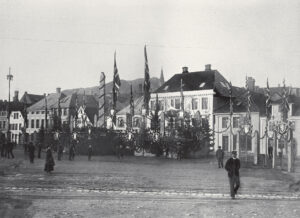
Few symbols are as closely associated with Bergen’s 17 May celebrations as the Viking ship at Festplassen. But the tradition began much earlier, and much more simply. Ceremonial platforms were built for Constitution Day as early as the 1850s, serving as both gathering places and decorations. Some were simple stands adorned with flags; others were larger structures decorated with standing stones.
What they had in common was that the city’s people and organisations gathered in front of them after marching into the celebration grounds.
A ship takes shape — and a tradition is born
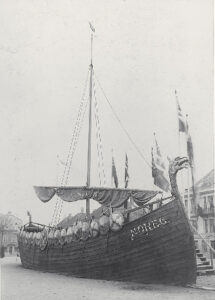
Something new happened in 1888: a Viking ship was erected as a ceremonial platform at Engen for the first time. It attracted considerable attention, and Bergens Tidende described it as beautifully decorated and especially splendid in the summer sunshine. The ship soon became a recurring feature, appearing several times between 1888 and 1905.
Other decorations appeared at Engen too. In 1891, an impressive artificial mound was built, complete with a standing stone, spruce trees and the city’s coat of arms. But it was the Viking ship that truly won Bergen’s heart.
In 1898, a new ship named Noreg appeared, surrounded by shields and spruce branches and flying a pennant bearing the year 872.
From Engen to Festplassen
After several years without a ship, including celebrations in Børneparken and by the Christie monument, the Viking ship returned in force in 1929 when Festplassen opened. For almost a century since, it has been the square’s natural gathering point, apart from a brief guest appearance at Koengen during the coronavirus pandemic.
The new ship was inspired by the elegant lines of the Gokstad ship and was built by naval engineer Ornell at Bergen Technical School.
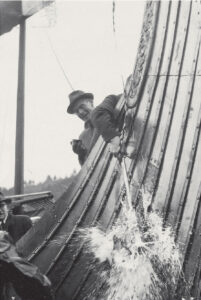
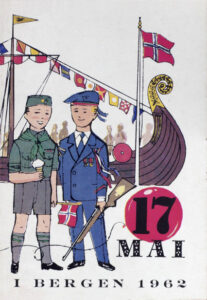
Throughout the twentieth century, the ship suffered from weather exposure and poor storage. By the early 1960s, its condition was so bad that the celebration committee’s chairman initiated a replacement. BMV made the steel structure, Askvik Båtbyggeri built the hull, and woodcarver Jacob Hjelle created decorations inspired by the Oseberg ship. The new ship was ready in 1962, costing NOK 42,000, half of which was contributed by the Bergen Shipowners’ Association.
The ceremonial christening took a little time: the champagne bottle had to strike the hull three times before it finally broke.
The modern ship — quicker to build and more practical
The fourth Viking ship arrived in 2005. Built by Ornes Båtbyggeri with carvings by boatbuilder Øyvind Hatlevoll, it cost NOK 1.5 million. Mounted on a trailer, it could be assembled in five hours rather than five days. For the first time, it had interior rooms: changing rooms, a guard room and even a toilet. Named Olav Kyrre, it was christened in true Viking style with mead, a drinking bowl and the music of Nystemten, watched by an enthusiastic crowd.
The latest version arrived in 2019. Parts of the 2005 Olav Kyrre were used to build a new ship more than twice as large, easier to assemble and equipped with better facilities.
A symbol Bergen cannot do without
The Viking ship at Festplassen is more than a backdrop. It is a Constitution Day symbol, a visual highlight and a familiar anchor in Bergen’s traditions. For most locals, it is as much a part of the day as the children’s parade, the buekorps youth brigades and the ice cream queues.
A celebration without the ship? For the people of Bergen, it is simply unthinkable.