
They began as simple lorries with planks on the back. Bergen’s russ vehicles tell a story of youth culture, tragedies and ever-increasing volume.
From lorry beds to sound machines — Bergen’s russ vehicles
They began as simple lorries with planks on the back. Today, they are rolling discos costing millions of kroner. The history of Bergen’s russ vehicles is a story of youth culture, tragedies and ever-increasing volume. Russ are students celebrating the end of upper secondary school.
The russ tradition began in 1905, when graduating pupils at an Oslo school adopted a red cap. Many others followed the next year, including in Bergen. It would take a few more years for russ culture to become prominent in the streets around 17 May, eventually with its own vehicles.
The vehicles arrive
In 1929, a striking new feature appeared: cars in the 17 May processions. The russ soon joined in. For a suitable payment, car after car travelled through Bergen’s streets, filled with excited young people cheering in the beautiful spring weather. A new era had begun: the russ on wheels.
Accidents followed too. The 1947 celebrations began dramatically for some russ from Fana. Early that morning, a vehicle crossing Danmarks plass lost its entire load, depositing fifteen students in the street. Morgenavisen considered this understandable given the improvised arrangements: obtain a lorry, put up a few planks and boards on the back, then load it with shouting and cheering youngsters.
Russ vehicles became increasingly common in the 1950s and 1960s. Young people from wealthy families drove the development. Advertising sponsorship later enabled students without rich parents to join in. Not everyone was pleased, and by the early 1960s the police were discussing limits on vehicle numbers.
Newspapers change their tune in the 1980s
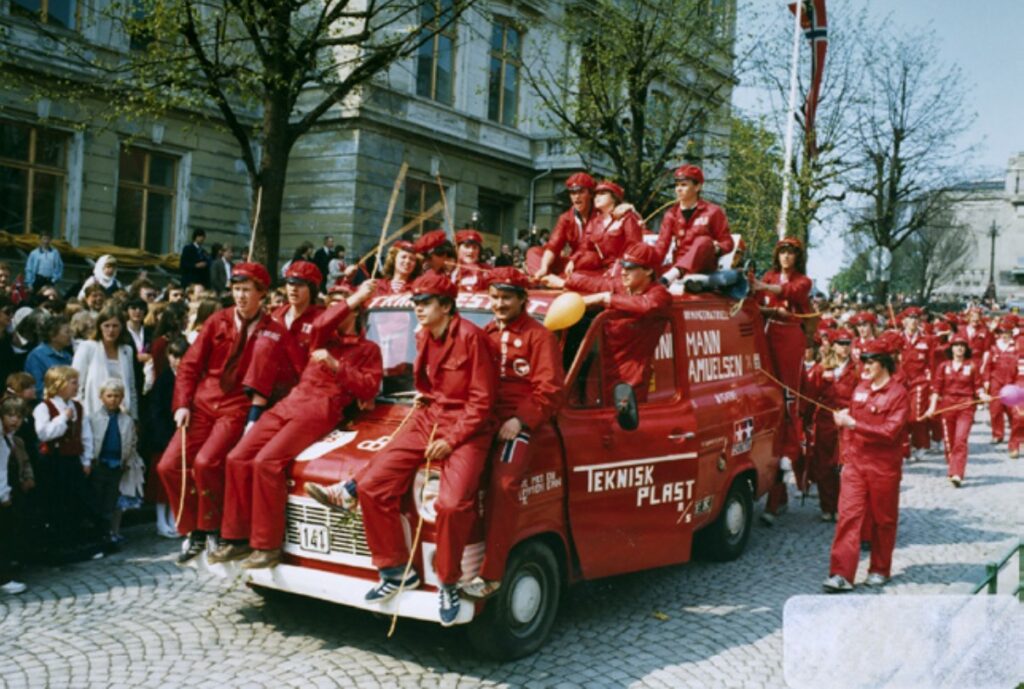
Newspaper attitudes have varied over time. From the early 1980s, the tone grew more critical and calls for restrictions returned repeatedly. The vehicles changed too. Early in the decade, most were old cars or vans painted by hand with brushes and rollers. Later, larger vans and minibuses became popular. Sound became increasingly important, with large homemade speaker boxes powered by car stereos pushed to their limits.
Safety has always been a concern, and in 1989 a terrible accident occurred. Five young people died and five were seriously injured when a Volkswagen minibus struck the wall at the entrance to Glasskartunnelen on Bergen’s northern approach road. Eleven young people, mostly russ from Åsane, were aboard. The crash followed an overtaking manoeuvre and became a dark chapter in the city’s russ history.
From van to bus — expansion in the 1990s
More russ groups acquired cars or vans in the 1990s. Commercialisation increased, though a strong do-it-yourself spirit remained. Old vans and even ambulances were bought cheaply and converted through shared voluntary work. Some russ buses appeared too. A vehicle could cost from a few thousand kroner to NOK 20,000, far below today’s million-kroner budgets. Further accidents brought greater attention to safety and stricter inspections by the Norwegian Public Roads Administration in Fyllingsdalen.
Bus fever — the 2000s change everything
Smaller vehicles still dominated at the start of the 2000s, but interest in large russ buses exploded during the decade. Budgets grew as groups of twenty to thirty students joined forces on extensive bus projects, sometimes costing a million kroner or more.
The authorities responded with increasingly strict inspections, and many buses were prohibited from use because of unlawful conversions. Their size and volume also caused difficulties in the procession. In 2004, only one russ bus was permitted in the 17 May procession.
In the 2010s, russ buses became fewer, more expensive and more professionally fitted out. Sound, lighting and design were often outsourced to commercial companies. Serious accidents, including an overturning bus in 2017, intensified the focus on safety.
Nevertheless, bus culture remained strong. Hordnesskogen, Haukås and Lagunen continued to be important gathering places for Bergen’s mobile russ.
A tradition under pressure — what comes next?
The government has sought stronger controls over russ celebrations, including stricter rules and closer oversight of commercial bus operators. The aim is to improve safety and reduce pressure on students and parents. Many wonder whether this means the end of the celebration as they know it, or the beginning of a new form.
In Bergen, russ buses have become a clear symbol of a costly and debated tradition. The original article describes a national ban on sideways-facing seats and standing passengers while vehicles are moving, introduced from 1 January 2026. Intended to reduce the risk of serious accidents, it would make many existing converted buses unlawful.
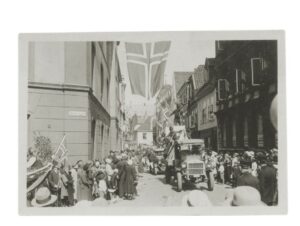
The relationship between the russ and their vehicles has long prompted debate. In Bergen, that conflict has rolled through the streets for almost a century. Could a new era now be approaching?
From the days before seat-belt rules.
Source: 17 May Committee in Bergen, Special Collections, University of Bergen Library.
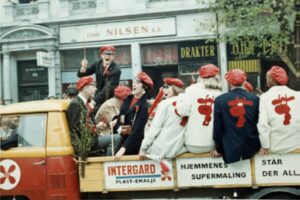
The original account describes putting planks and boards on a lorry bed and loading it with cheering, shouting youngsters.
Source: 17 May Committee in Bergen, Special Collections, University of Bergen Library.
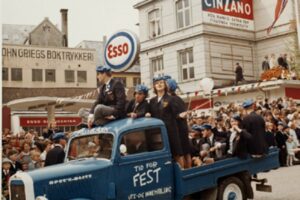
17 May 1983. How many people can fit into a russ vehicle?
Source: 17 May Committee in Bergen, Special Collections, University of Bergen Library.
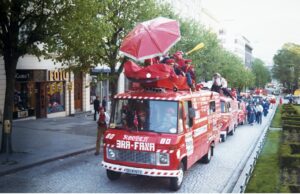
Russ vehicles were frequently criticised. A convoy of red russ vehicles in 1982.
Source: 17 May Committee in Bergen, Special Collections, University of Bergen Library.
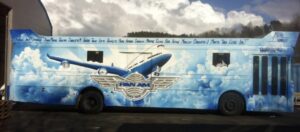
The transition from russ cars to buses: Pan-Am 2012, owned by a group of girls from Bergen.
The bus won Concept of the Year in 2012 and was also recognised for its focus on safety and strict rules, including designated on-duty trip leaders. Source: Pan-Am’s own Facebook page.
Russ bus interiors look very different from the earliest planks and boards on a lorry bed.