Bergen’s children’s flag parade began in 1877. At first, only boys could take part, carrying red, white and blue pennants.
Here come the children!
In 1869, headmaster Peter Qvam in Christiania had the idea of organising a children’s parade for pupils at Maribogadens Latin- og Realskole. Bjørnstjerne Bjørnson supported him the following year, and the capital’s first children’s parade took place on 17 May 1870.
Bergen followed seven years later, in 1877. That year, the city’s newspapers invited boys wishing to take part in the flag parade to assemble at Skansen at 09:00, carrying poles in their hands.
The event was first called the boys’ flag parade, for the simple reason that only boys were allowed to participate. Strictly speaking, there were no flags: the boys carried red, white and blue pennants. Committee chairman John Lund, who initiated the parade, did not want the Norwegian flag with its union emblem, nicknamed the “herring salad”, included. Swedish symbols were not to define Norway’s own national day.
The boys lined up three abreast, with red pennants on the right, white in the middle and blue on the left. Newspaper notices told older boys it was their duty to look after the younger ones. There were no marching bands in the first parade. Instead, the boys sang, including songs still used today such as “Se Norges Blomsterdal” and “Vi ere en Nation”.
The parade left Skansen, descended to Torget and joined the main procession behind the sailors. Together they followed Strandgaten to Nordnes, then crossed Klosteret and Kalmargjerdet to Engen, where songs, speeches and cheers concluded the event. Bergens Tidende reported more than a thousand boys in a parade it considered among the loveliest sights seen locally. Before long, young girls in traditional dress and marching bands were invited too. Ever since, Flaggtoget has been among the world’s most beautiful 17 May traditions, and it remains so today!
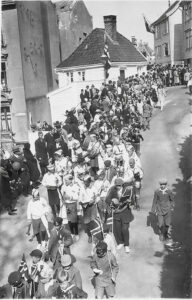
A school marching band descending Skansesvingene in the 1930s. Photographer unknown. Source: Picture Collection, Special Collections, University of Bergen Library.
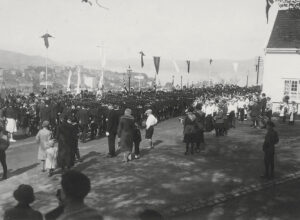
Skansen was the traditional assembly point for the flag parade. This photograph is from the 1930s. Photographer unknown. Source: Picture Collection, Special Collections, University of Bergen Library.
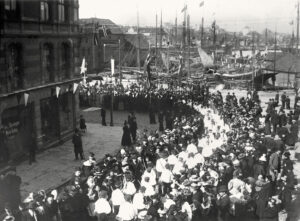
The buekorps usually joined the flag parade. Laksevågs Buskyttere march at Bryggesporden in 1898. Photo: O. Irgens. Source: Picture Collection, Special Collections, University of Bergen Library.
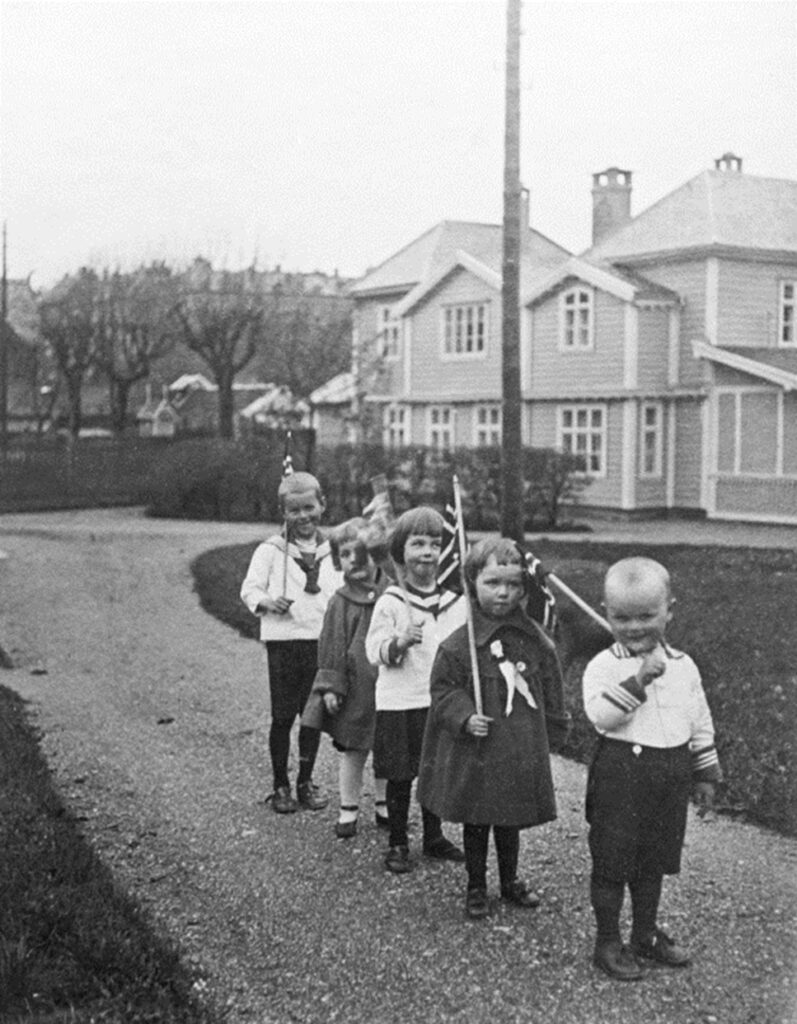
Starting young: excited children ready to join a parade long ago. Photographer unknown. Source: Picture Collection, Special Collections, University of Bergen Library.
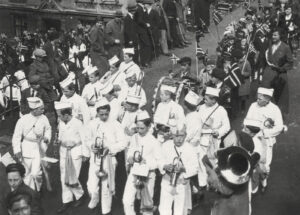
One of Bergen’s boys’ marching bands descends Skansesvingene in the flag parade around 1930. Source: 17 May Committee’s archive, Manuscript and Rare Book Collection, Special Collections, University of Bergen Library.
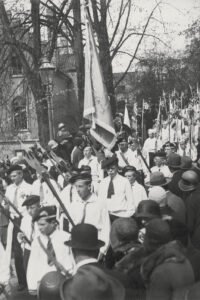
Løvstakken Jægerkorps in Skansesvingene around 1931. Photographer unknown. Source: Picture Collection, Special Collections, University of Bergen Library.
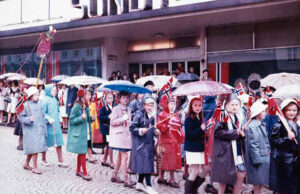
17 May was often wet in the 1960s, but spirits stayed high. Optimists pointed out that it could have been worse: a southerly gale might have joined the rain. In 1964, Bergens Tidende described the children’s parade as a procession of colourful plastic and nylon. Photographer unknown. Source: Picture Collection, Special Collections, University of Bergen Library.
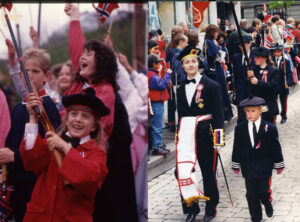
On 17 May 1992, Vågens bataljon, a girls’ buekorps, joined Flaggtoget for the first time. Its red-clad ranks numbered 106 girls. Three years later, Lungegaardens also marched through the city. Photos: Ø. Deiz / A. Nilsen, BT archive. Reproduced from B. A. Bagge, En velsignet søttendes, Bodoni, Bergen, 2014.
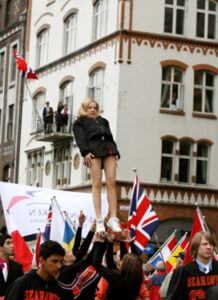
Cheerleaders have also become part of Flaggtoget. Here are the energetic Åsane Seahawks cheerleaders. Photo: M. Aarekol, BT archive. Reproduced from B. A. Bagge, En velsignet søttendes, Bodoni, Bergen, 2014.